The Holberg School Programme welcomes research projects conducted within or involving the school subject English. This text aims to explain how such a project can be conducted and defended in light of the current English curricula. It also highlights some of the English-language projects we have received throughout the years, in addition to two projects written in Norwegian, both exploring the relationship between the English and Norwegian languages.
In the near future, links to one or several teaching plans will also be found within this text. These plans have all been successfully implemented in classrooms by English teachers as a part of their students’ participation in The Holberg School Programme.
The current curricula
The current English curriculum in vocational studies demand that students make use of exploratory methods of learning. It states that students shall explore and present at least one topic related to language, culture, society or science through a critical use of English-language texts and other sources. This aim would be covered in depth by a Holberg School Programme-project, which allows the students to thoroughly explore a topic of their own choosing, and write a longer, academic text presenting findings and analyses related to their research. This activity in itself covers several other aims in the curricula, among them aims related to the use of a rich, precise and varied vocabulary in written English, and the one saying students should be able to draw on different sources in a critical and reliable (etterrettelig) manner. Another highly relevant aim is the one stating that students shall produce academic texts in a style and structure suitable to the purpose at hand.
In the core curriculum, it says that school “shall help pupils to be inquisitive and ask questions, develop scientific and critical thinking and act with ethical awareness.” In achieving this aim, teachers shall help their pupils develop their abilities to “assess different sources of knowledge and think critically about how knowledge is developed.” We think a research project within the framework of The Holberg School Programme is one of the best ways to achieve these core values and competency aims.
Surrounded by English on all fronts
The English language itself and current/recent events in the English-speaking world – not to mention an enormous variety of cultural products from these areas – surround the average modern Norwegian to a degree unparalleled in our history. English-speaking, above all American, culture has conquered considerable ground in the minds and lives of Norwegians in the decades since the Second World War. This has undoubtedly been to the detriment of languages like French and German, and their associated cultures.
Given the fact that we are literally surrounded by English on all fronts, one usually doesn’t have to think very hard to come up with ideas for potential English-related research projects. Take the amount of English-language social media “content” on our phones, for example. It is considerable, to put it mildly, as is the number of more traditional media products in English. The prominence of English is perhaps above all noticeable in our everyday language. In many instances, parts of our English vocabulary are more readily available than our native one; Many of us rely on English when we can’t find the right word in a Norwegian conversation.
Projects written in or involving the English language
The topic mentioned above has in fact already been explored by students as part of the Holberg School Programme. In the research project “Norwegian is ‘Basically’ Dying Out”, students from Heggen Upper Secondary School investigated young people’s attitudes to the English language’s influence on Norwegian. As the title indicates, some of their informants cannot be said to have a positive outlook on the future of their native tongue…
Comics and graphic novels from the Anglosphere are examples of cultural products that are enjoyed in their original language – as well as in translated editions – by many in modern day Norway. Erika Lind-Larsen from Vestby Upper Secondary School participated in the Holberg School Programme in 2024 with the research project “Lost in Translation?”. This project centers on the graphic novel Heartstopper in both its original and Norwegian-language edition. Lind-Larsen asks what is “lost” when a text is translated from one language to another, and whether this loss is of importance to the reader’s overall experience. The topic of representation in fiction is perhaps more relevant than ever, as previously marginalized communities are lifted into the light, in fiction and elsewhere. Fan literature, written outside the major production companies and publishing houses, has long been an arena where identities under-represented in commercial productions or publications, have been given space. This phenomenon was explored by Maria Kolle Ramberg from Oslo Cathedral School in her 2023 contribution Queer Participation and Representation in Fan Literature.
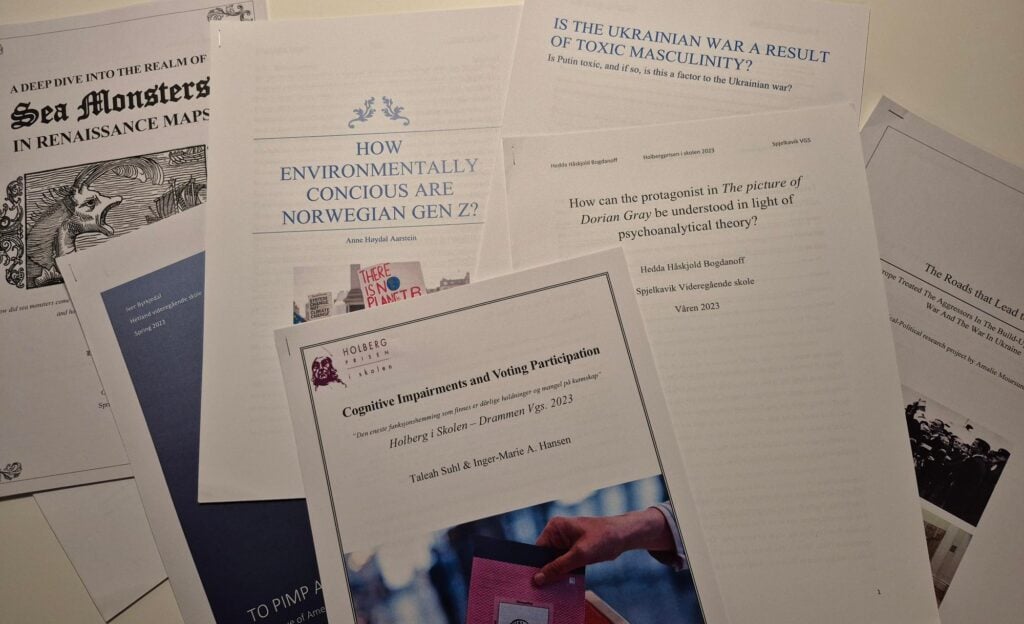
Other English-language contributions in the Holberg School Programme have explored topics as varied as George Orwell’s dystopian novel 1984 and its parallels to modern day USA (2025, Oslo Cathedral School), the war in Ukraine, and whether the outbreak of this conflict is related to the concept of toxic masculinity (2024, Hetland Upper Secondary School), news coverage of the 22 July massacre in Norwegian and American media (2014, Askim Upper Secondary School), young people’s environmental consciousness (2023, Oslo Cathedral School), and the lead-up to the Second World War in Europe (2023, Oslo Cathedrak School). Other projects have investigated sensitive subjects such as suicide (2024, Hetland Upper Secondary School), how environmental and psychological factors impact the academic achievements of children (2024, Hetland Upper Secondary School), and the voting participation among citizens with cognitive impairments (2023, Drammen Upper Secondary School). Other English-language research topics and questions, all explored by students at Oslo Cathedral School in the 2024/2025 round of the Holberg School Programme, are listed below:
Social media’s effect on youth
Effects of segregating short-residence students in school
Apocalyptical games: what characterizes dystopian gaming?
The importance of reading aloud in childhood and old age
White-washing in anime
Comparing the views on cars in rural and urban areas
Sports-washing: does it affect the popularity of football?
Chernobyl: the TV miniseries vs history
Students, technology and social media
Young people and reading: why they should read The Great Gatsby
The importance of lighting in movies
The ethical challenges of AI
The importance of teachers’ mental health for learning
Comparing test results in “East” and “West” Oslo
Teacher’s motivation and expectation’s effect on students
Comparing the Victorian rest treatment in three feminist texts
AI in teaching: from the students’ and teachers’ perspectives
Totalitarianism in the US – through fiction and reality
Scottish folklore – how much is true?
Da Vinci’s inventions and their effect on military development
More more inspiration on and proposals for a variety of in-depth study projects in English, check out NDLA’s site on the topic.
A truly explorative way of learning
As the many examples above illustrate, the possibilities for explorative learning – thematically, methodically and interdisciplinary – through an in-depth research project in or involving English, are close to endless. The Holberg School Programme provides all participating students and teachers with relevant and necessary guidance and assistance until the research projects are completed, in April each year.
But regardless of whether the research is done as a part of The Holberg School Programme or not: We firmly believe work on in-depth research projects are of immense benefit to the students involved. Working on such projects is an efficient way to fulfill many of the most central aims in the curricula, and above all to foster in-depth learning. In addition, reading and writing of longer academic texts is a productive and meaningful method for the students to develop and strengthen their overall college readiness.
Lærerressurser
Sist endret:
Publisert:
Written by: